Skip to content

Posts by drjbnewman

More Wisdom from my Brother

Perhaps the most contradictory sounding idea that my brother Mark often talked about was something I’ve been reading a lot about lately. That idea is being a humble leader. Mark believed that the most important quality of any great leader is humility. His observations and experience taught him that leaders who remained humble had followers who were willing to do more than followers being led by braggarts and blowhards. He strongly believed that the most dangerous quality in any person in a position of authority was having too big of an ego. Thinking too much of oneself is tantamount to thinking too little of others.

One of Mark’s real leadership heroes was John Wooden. Coach Wooden came from very humble beginnings and rose to the pinnacle of college basketball coaching. In a 12 year period, Wooden’s UCLA Bruin basketball team won 10 NCAA Basketball championships. If anyone had the right to be proud of his success, John Wooden certainly did. But Coach Wooden never used that success to curry favor in the world. There is a well known story of Coach Wooden attending a baseball clinic and waiting in the registration line with everyone else. The director of the clinic spotted him in line and beckoned him to come on up to the front of the line but Coach Wooden waived him off and told those waiting in line with him, “I am no better than anyone else waiting in this line. I can wait my turn just like everyone else.” When you’ve coached ten teams to the National Championship Title, very few people would take offense if you jumped the line but that just wasn’t the way Coach Wooden did things. He was truly a humble leader.

Mark taught all his players and coaches the importance of humility. Mark, himself, was a humble person. He earned 5 World Series Rings for his work with the New York Yankees. He loved each one of those but rarely, ever wore them. He felt they were way too pretentious to be worn. He was proud of his accomplishments but his humility would never allow him to lord his position or power over others. He did so much of his work out of the limelight. Few people would ever know what he accomplished. But those people he helped knew what he could do and they have shared their feelings about what Mark taught them and how he helped them. But he did not broadcast that to the world. Mark took a page from John Wooden’s book and made that his playbook for life. The centerpiece of that playbook was humility.

Wisdom from my Brother

A couple weeks ago, my brother Mark passed away quite suddenly, and very unexpectedly. Losing a loved one is always hard and my family has dealt with the shock with a lot of tears but also many smiles as we remember so many things about our lives together. Mark was a very hard working guy yet he loved his work. His life was baseball and he spent 50 years coaching and helping players develop into top notch contributors to their teams. The last 26 years of his career were devoted to a team he loved from the time he was 8 years old, the New York Yankees. His dedication to the Yankees could be witnessed through the hours he spent and the miles he traveled to find the best prospects possible to play in the Yankees system. Hall-of-Fame inductees Derek Jeter and Mariano Rivera were two of the hundreds of ball players Mark helped bring into the Yankee organization.

Mark knew that just bringing a young player to the team did not mean that player would achieve success. Each new prospect would need time to develop their talents and skills. It would take years of hard work and dedication to reach the pinnacle of achievement in the highly competitive world of Major League Baseball. A constant refrain many heard from Mark was “doing your best is not enough! Too often when someone says ‘I’m doing the best I can’ what they’re really saying is I can’t do any better and as soon as you say that and believe it, you’re done. Our mission is to continuously improve; get better every day.” That philosophy helped the Yankees win 4 World Series Championships during a 5 year period, 1996 to 2000. They won one more during his tenure as Senior VP of Baseball Operations, 2009. During his 26 years with the Yankees, the team made the post season playoffs 18 times and had 7 trips to the World Series.

I was able to spend many hours talking with Mark about leadership. It was a passion we both shared. We read many of the same books and applied many of the same principles in our leadership careers. He lived his philosophy of always striving to get better. He would not rest, even after he retired from the Yankees in 2014. In retirement he created the Florida Baseball Institute. Players and coaches from around Florida, and beyond, came to his facility to learn from one of the best. His legacy will live on through the hundreds of players, coaches, managers and baseball executives that learned their craft, in part, from him. I will miss him dearly but so will countless others who grew to love him for the indelible impact he had on all our lives!

Legacy Leadership and Capitalism

Some people believe that being a capitalist means you have to care more about making money than people. Some of the people who believe that are capitalists while others are socialists. In many situations, these people appear to be correct. But, I have seen numerous companies where that concept does not appear to be true. In each of these cases those companies are led by people I consider to be Legacy Leaders. Legacy Leaders make money, and often a lot of it, but they do that by truly caring for everyone that helps them do that.

I have personal experience with several leaders that care so much about their people that they share their gains with them. They listen to them. They adjust their behavior and procedures based on what they hear from their people. They believe the culture of their company is critical to the company’s success. Life is not always free from difficulties and neither is the world of any business. But, the Legacy Leader doesn’t suffer through those difficulties alone. The Legacy Leader engages everyone in the organization to help weather those storms just as they engage everyone in the celebrations of success.

When I look at the world around me, I see many examples of incredibly caring companies but I also see way too many many companies that just don’t care at all. They may say they care but all the evidence points to selfishness and a serious lack of caring. When a company can be fined for their bad behavior, not just once, but numerous times! They really don’t care. When employees leave a company as soon as they have the opportunity! They really don’t care. When the executives are paid hundreds of times more than wages paid to workers! They really don’t care. Legacy Leaders share the financial success just as they share the financial hardships. The selfish share only the hardships.

All of the true capitalists out there; you could change the world’s perception of capitalism in a very few years. Switch from caring more about money than you do people. Accept the very real fact that to make money requires people. If people are tools you use to make money, they figure that out. If people are critical parts of your company’s success fabric and are treated like they are important to you, they figure that out as well. If you are an organizational leader, you have a choice as to how you will lead that organization. Picking the Legacy Leader approach will pay dividends no other way can provide. Their will be financial dividends, human dividends, social dividends, and, quite likely environmental dividends as well.

Power!

All of us want more power! Power is the possession of control, authority, and influence over others. Too many people feel totally powerless. People look around them and see examples of others who appear to have loads of power, while they perceive that they have very little. What can they do? How can the average human being increase their own control, authority, and influence over others? Here’s what I have learned over the broad expanse of my 70 years on this planet.

Power is never really taken, it can only be given. Sometimes we give our power to others because we fear the consequences if we don’t, but during most human interactions today, we have many more choices than just fight or give in. Our power comes in many forms and in each form we have the choice of whether we give it to others, our keep it for ourselves. The classic child-parent struggle typifies the fundamental human battle for power. Children do not want to be controlled but parents need to control them due to schedules, safety concerns, and the general well-being of their children. But let’s look at power from our adult perspective.

We often hear that knowledge is power. Why would knowledge be power? The answer to that question is quite simple. If I know something that you don’t, I may have opportunities that you do not. It’s actually the opportunity that brings us power. In fact, I believe that opportunity is the source of all power. The wealthy have more opportunities. Those with higher status have more opportunities. The more highly educated have more opportunities. The very strong have more opportunities. Those that possess special skills or talents have more opportunities. If you can do something very few others can do, you will have more opportunities. The more opportunities we have, the more power we have.

People who have power can, sometimes, be afraid of losing their power. This can lead them to believe that they must do certain things to secure their power. Sometimes those people will try to limit the opportunities available to those they currently control, have authority over, and wish to continue to influence. Others, those who are true leaders, “legacy leaders,” have learned that by increasing the opportunities for followers is actually the best way to preserve their power. Legacy Leaders understand that sharing power and opportunity is the source of the greatest power of all, the explosive power of “love, trust, faith, and belief!” To put this power into one word, it is the power of “Devotion!” Very few people have ever acquired this power. It is wielded without fear and without force. It’s the purest of all powers. It is never used for harmful outcomes, only for the good of all. Do you know anyone like this?

Finding the Secret!

Everyone wants to know what the secret to success is. Millions of dollars are spent each year trying to figure out some extraordinary formula that guarantees success. I have personally read a number of books trying to ascertain what the real secret is. After more than 50 years of searching, I’ve finally figured it out. There is a secret, but it’s not out there somewhere. The secret is buried deep within ourselves. We must each find our own secret. It is possible to follow a guide to our secret, but that guide can only help you navigate your path. The guide will not know when you’ve reached your secret, only you will know that.

So what was the secret to my success? My secret was a very simple, uncomplicated secret. It is the realization that I am the only person who has the right to define me and my path to success. Upon accepting this self-truth, I discovered I am an uncomplicated human being with very straightforward beliefs and expectations. I believe that my success is derived from my work ethic and that work ethic is best stated as “anything worth doing is worth doing well.” Therefore, success is a product of my effort and the quality of the outcomes I produce.

My success is not dependent upon the acceptance of my work by anyone but me. If another person is not pleased with what I have done, I will certainly reflect on what I have done and I may choose to make improvements or modifications, but ultimately, the only qualifier for my success is that I accept that the quality of my work meets the expectations that I have established for myself. I realize that I am my own worst critic and that I may over analyze the work I have done. I may be too perfectionistic on many tasks and thus may take too long to complete some. But, if I am to consider myself successful, it is my expectation that I will do the best job I possibly can.

Success to me is not measured by wealth. It is not measured by position or status. Success is measured by the value I add to the world in which I live. I follow a simple philosophy. Leave each place I go better than I found it when I first arrived. In order to do this, I have to be cognizant of what condition each place is in. To attain this awareness requires me to be open, observant, aware of my biases, and above all, honest. This may seem like I’m getting very complicated here, but I still believe this is all very simple. Give my best effort in doing the best work I can and make each experience an improvement for everyone. This is my secret to success. What’s yours?

Life Changing Ideas

As we proceed through our lives, there will be, from time to time, ideas that change our lives forever. I have experienced such ideas, as I am sure you have as well. During this Coronavirus Pandemic, I have seen very few of these ideas emerge. This has troubled me. As a true thinker and seeker of greater understanding, I have asked myself, “is this true?” “Have I missed, some really extraordinary ideas?” “Or, is something going on here that is getting in the way of new, innovative ideas?”

My examination of what’s going in our world has led me to some interesting observations. I’d like to share a few of them with you. First of all, how arrogant so many of us are (me definitely included), to believe we can be aware of even a fraction of the new, innovative ideas that are presented every day. Second, with the world so focused on the Pandemic, most great thinking is having a difficult time getting anyone to pay attention. Third, in times of great threat, huge masses of people pull back into their own “safe-space” of thinking, which makes innovative contemplation much more difficult. Fourth, the political climate of the US, and many other parts of the world, is so dysfunctional that it has become hazardous to be an innovative idea generator. Finally, because this pandemic has not only had physical health consequences but social, emotional, psychological, and spiritual consequences as well, too many people have not been ready to listen innovative, life changing ideas.

This realization, that Covid has really messed up “our thinking,” has led me to my latest life changing idea. Openness is essential for living our fullest life! Being closed makes it impossible to be fulfilled. This may not be an earth shattering concept to you, but I had never given this idea much thought in the past. As I have investigated what’s going on in our world today, I see the incredible damage that being a closed society has done! When an entire society engages in “closed behaviors,” the number of victims pile up. I had previously thought that most victims are only victims because they think of themselves as victims. I now see that closed societies thrive on victimization. It is how they maintain their status quo. Open societies, in contrast, are diminished when anyone is victimized!

So, how do we change from closed to open? It is a very simple but very difficult process. It’s simple because all you have to do is accept everyone as your complete, unconditional equal. It’s difficult because our biases will get in the way of that unconditional acceptance. Most of us will rationalize our rejection of some people because of who they are and what they’ve done. That, however, is mistaken thinking. Accepting people does mean we have to accept their behavior. Rejecting people does not mean that we have rejected their behavior. We too often reject people because we think they have, or might in the future, do something we find unacceptable. And, we too often accept people because we feel like they would most likely do what we would do without any evidence that the notion might be true. Being open is simple but hard. Being closed is very complicated but pretty easy to do. Being open requires us to engage in self examination. Being closed does not. Self examination requires that we take a very critical look at our own motives and biases. This is not comfortable. And this is the most striking aspect of an open society; they are not built for comfort. In fact, all open societies are less comfortable than closed societies! This makes them less desirable in the eyes of many people but more important than ever.

A Brave New World?

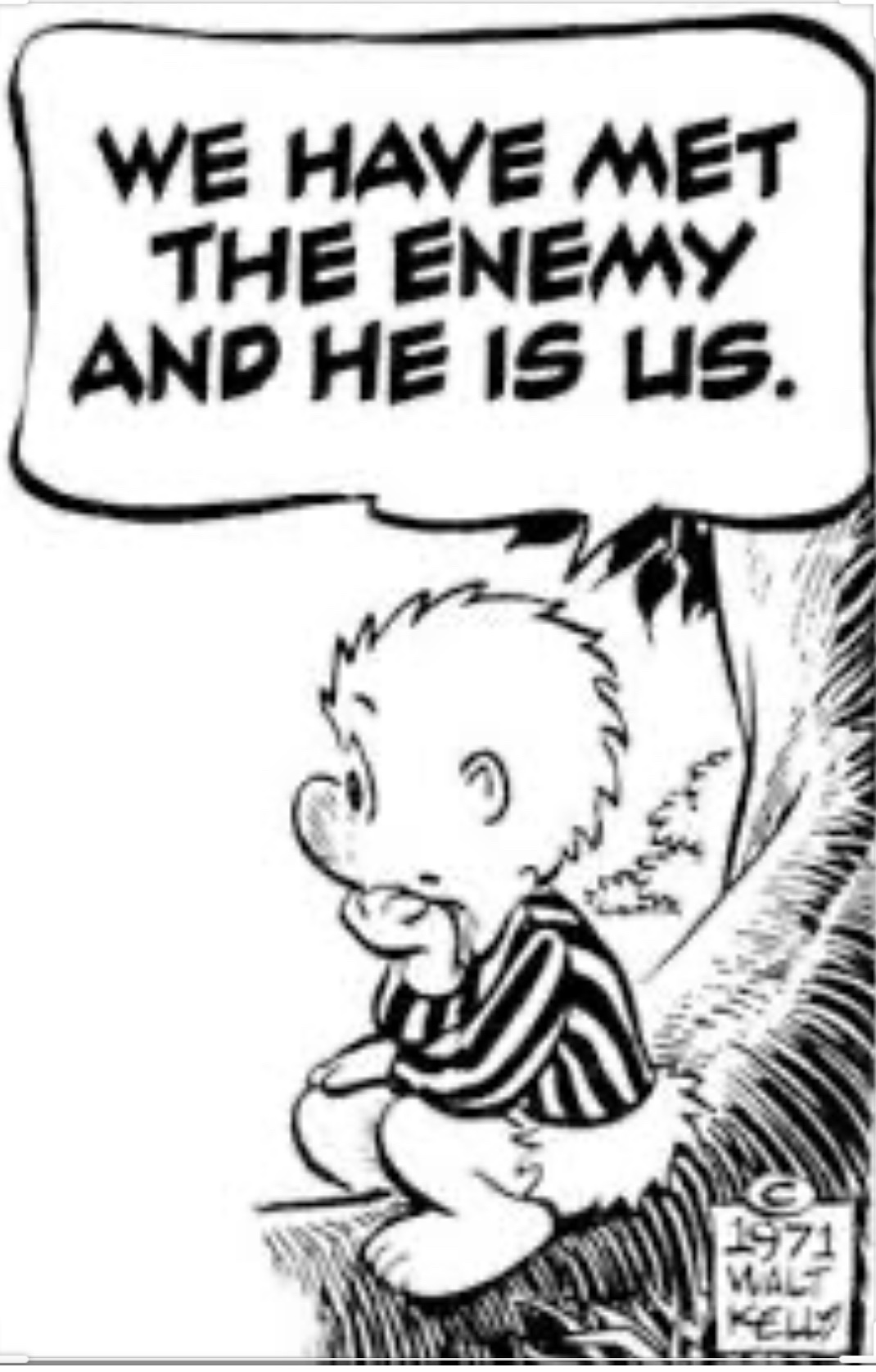
We are at war! Not with a horrific enemy. Not with ISIS, or Al Qaida, or Russia, or even China. We are not at war against the Coronavirus. We are at war with ourselves!

This 1971 Pogo Comic said it all!

I’ve asked myself “WHY?” I’ve searched my mind and I’ve search my soul, and I’ve come to a conclusion. We have a crisis based on a lack of trust! Nobody trusts anyone anymore, if we ever trusted anyone, ever. I recall my early years and I think we trusted a lot of people. We trusted our neighbors and they trusted us. We trusted our Leaders, the milkman, the postal workers, the teachers, the preachers, the news broadcasters, the doctors, and the police. Why don’t we trust these people now? What did they do to earn our mistrust?

In my estimation, they haven’t done anything different, but we have. We are constantly believing what we read that feeds our biases. We’ve actually always done that but today, we see hundreds of different sources of information every single day. 60 years ago, we had maybe 3 or 4 sources of information. These sources either fed our biases or they provided an alternative point-of-view. We took it all in and sorted it through our filters. Today, information comes at us from so many sources and so much of it is misinformation! If that information feeds a bias, we will, most likely, just accept it as truth. If the information is contrary to our bias, we will very likely reject the the information. Either way, without a little digging, what we accept as truth and fallacy runs a very real risk of being completely wrong. Because too many of us are accepting misinformation as being real, honest, absolute truth, huge swaths of society have been maligned.

How can we trust people who think, look, behave, and believe differently than us? It’s nearly impossible as long as we accept the very biased proposition that such people are bad, or even worse, evil! In order to trust those who are different, we must recognize our biases, deliberately set them aside, and wholeheartedly declare that it’s not only ok to be different than me, but actually celebrate those differences. Jesus did not tell us to only love those who think, look, behave and believe like us. He said “love your neighbor.” He said, “as you have done to the least of these, so have you done to me.” He welcomed the outcast, the adulterer, the tax collector, the sick, the lame, the poor, the homeless. He only excluded those who hard-heartedly excluded others. But, even for those he left the door open. Change your ways from hatred to love and you too can become part of the family.

We can turn this mess around. It will mean taking a risk. It will mean being open and honest about our biases, and we all have them. Think of the things that people say and do that make you angry. Why do you get angry? Because of your bias! Our biases are not bad. But acting based on a bias, when huge chunks of objective evidence says it is wrong to do so, now that’s bad! And it’s not ok to cherry-pick the evidence you want. That’s bias at its worst. A major part of the problems we face are a direct result of cherry-picked evidence. When you only consider the data that supports your point-of-view, that’s bias at work. Setting our biases aside opens us up to many possible outcomes; some good, some bad. But, if we can get others to set aside their biases as well, the chances of negative outcomes are greatly reduced. The more we can eliminate bias, the more positive the potential outcomes become. In order to turn this mess around, we must reduce the impact of bias and increase the influence of trust.

The Power of Bias

We are all biased! Not a single one of us lacks bias. We are biased about absolutely everything. Clothes, food, housing, transportation, nature, and yes, people! It is impossible to eliminate bias. It is a survival mechanism. It is not, however, impossible to limit the impact of our biases. But, it is very hard to do and takes an incredible amount of patience, energy, and just difficult, strenuous, and sometimes painful work!

Our biases exist to keep us both physically and emotionally safe. But, our biases can be harmful to ourselves and to others. If we refuse to recognize our biases, we can make decisions that lead to behaviors that are destructive. My bias towards chocolate covered peanuts, if not checked could result in excessive weight gain and a long list of other health issues. My bias towards people who are like me could prevent me from learning about different cultures and everything those cultures have to offer. My bias towards people like me might result in my attribution of all sorts of bad things to people who are different! This has happened in my life and it has happened in your life too. I admit it regarding my life. Can you admit it about your life?

Once we admit that we are biased, we can do something about it. As long as we hang onto the myth that says I can be totally unbiased, we run the very real risk that we will be controlled by those biases we refuse to recognize! Bias is not associated with any specific political ideology. It exists in socialists as well as fascists. It exists in Republicans, Democrats, Libertarians, Communists, Green Party members, and any other political affiliation you might want to name. We are all biased! Let’s just admit it and start working to reduce the impact those biases have that are detrimental to one another and to our society as a whole. Right now, we can’t work together because we all think it’s the other guy that’s biased.

Here’s what I propose we all do. We should all start our interactions by introducing ourselves and our biases. We can offer up some of our more mundane biases and maybe three of our biggest and potentially most harmful biases. I’ll start off. Hi, I’m Jay Newman and here are ten of my biases: I love chocolate but I hate Lima beans. I love the Chicago Bears but really don’t like the Packers. I prefer to work on projects that I can control from the beginning to the end. I prefer living in a more rural setting and get very nervous in large, not very well kept urban areas (I’ve lived in both). I prefer more moderate faith driven Christianity. I prefer conservative fiscal ideals and moderate to mildly conservative social values. But I prefer to be more pragmatic in how we deal with both fiscal and social issues. Here are the hard ones. Yes, indeed, I prefer to be with people who look and act like me; white, middle class, educated, middle of the road, hard working, neat, tidy, lovers of classic rock! I can list more biases but this is safe start. I’d love to hear what others are willing to share. I believe if we can bring our biases out onto the table, we can start working together to make our world a better place.

Is Anybody Else Exhausted?

It seems that everywhere I turn, I read or hear so much misinformation. We can’t get away from it. It’s everywhere. It’s like chicken droppings in the chicken coop! You can’t move without stepping in it! Has our world gone totally nuts? There are so many conspiracy theories out there and, oh my goodness, those conspiracy theories cover everything from Covid19, to Global Warming, to Presidential Elections. One of the misinformation pieces I’ve seen more times than almost any other is the 28th Amendment. Our US Constitution presently has 27 Amendments. The 27th Amendment was actually part of the package of 12 amendments offered when our Constitution was written. It was passed by Congress in 1789 but did not get passed by two thirds of the states until 1992; over 202 years later. This Amendment is known as the Congressional Compensation Amendment and it prevents Congress from giving itself a raise until after an election is held. So if Congress passes a budget bill that includes a raise for itself, the raise cannot go into effect until after the next election. Now, what about the 28th Amendment? If another Amendment is passed by both houses of Congress and is ratified by 2/3 of the states, that will be the 28th Amendment. The so called Congressional Reform Act has never been introduced into either house of Congress and therefore only exists in the continuous misinformation cycles that have hit the internet for the last 10 years!

All of these misinformation campaigns are exhausting! Masks are not harmful to your health! The preponderance of research, the overwhelming majority of the research, tells us they are safe, unless you are talking about Halloween masks when the eye holes aren’t aligned with your eyes, then those masks might be dangerous. Another one I keep hearing and reading about is that global warming is caused by increased solar activity. Well astronomers who carefully study our Sun tell us that solar activity is actually down over the last numerous solar activity cycles. A solar cycle lasts 11 years. During those 11 years solar activity goes from its highest activity to it lowest activity and the back to the highest. That cycle takes 11 years. When you look at the data from the last 120 years, you see that the last 2 sun cycles have lower sun activity than the previous 8 cycles. If solar activity was causing global warming, I’d think there would be higher activity during these last 2 cycles. People spout off about things that don’t make sense to me. My background is science. I expect the data to support an argument, but in all of this noise I’m hearing these days, I’m just not seeing the data!

I’ve decided to stop correcting people. It’s wearing me out. I’m going to let them wallow in their own thought process. I’m too tired to fight it anymore. Go ahead, believe what you want. As far as I’m concerned, I’ll keep looking at the data and the statistical analysis of the data to inform me as to what’s real, what’s most likely true, and what’s fake or most likely false. One observation does not prove a point. A few events don’t create a trend. Careful analysis of well designed studies, supported by statistically significant data, repeatable and tested for reliability and validity. You see, it’s not just about having a bunch of data to prove a point. Is that data reliable? How was it collected? How accurate were the measurements? If you repeat the study, do you get reasonably similar data? And how valid is the data? Is the data you are collecting really related to the outcomes you are looking at? It’s not easy being scientific. It’s a whole lot easier to make a few observations and make a conclusion. But, I can’t help myself. I have to look at the research and come to my own conclusions. I’m going to continue to do that and let everyone else believe what they want. I just don’t have the energy to keep correcting the misinformation!

Collecting the Right Data

Today, many businesses want to make data driven decisions. And, believe me, it totally makes sense to want to make decisions based on more than a gut reaction to what we see in our world. But making decisions based on the wrong data can be even less productive than making a decision based on “instinct!” Knowing what data to collect, so that you can make quality data driven decisions, begins with knowing what areas of your business need to be improved. Unfortunately, too many businesses don’t know what needs to be improved. This is too often because many businesses only have financial data. They know their P & L, but have no clue about critical, non-financial key performance indicators.

Here are 5 non-financial key performance indicators (NFKPIs) we measure with our clients: Culture, Operations, Leadership, Training, and Service. By asking employees to rate several statements as being extremely true, very true, somewhat true, not very true, or not true about specific aspects of your business regarding those 5 NFKPIs, we can acquire data about these critical areas of a business. But this is not enough. We need to not only know what’s true about your business, we need to know what’s important to your business and how well your business executes it’s strategies and tactics in these 5 NFKPI areas. At Culture By Choice, we use the Performance Gap Indicator, or PGI, to help many of our clients acquire critical data in these 5 NFKPI areas.

The PGI makes 21 statements that employees rate as either being extremely true, very true, somewhat true, not very true, or not true. It then makes 12 statements that employees rate as being either extremely important, very important, somewhat important, not very important, or not important. Finally, it makes 12 statements that employees rate as being either extremely effective, very effective, somewhat effective, not very effective, or not effective. As a result of this survey, a business acquires data regarding these 5 NFKPIs and can make decisions about where it wants to start making improvements. We always recommend working on only one or two strategies at any one time. Working on more than that dilutes efforts and focus and as a result the chances of success are diminished.

You can achieve data driven improvements in your business and we can help. Let us give you an idea as to what it would take to get that data. We can help you get the data and develop specific strategies that can drive significant improvements in your business and we can do it at a cost that your business can afford. Consider it, I really believe we can help!