Legacy Leaders and a Personal/Organizational Purpose (Ikigai)
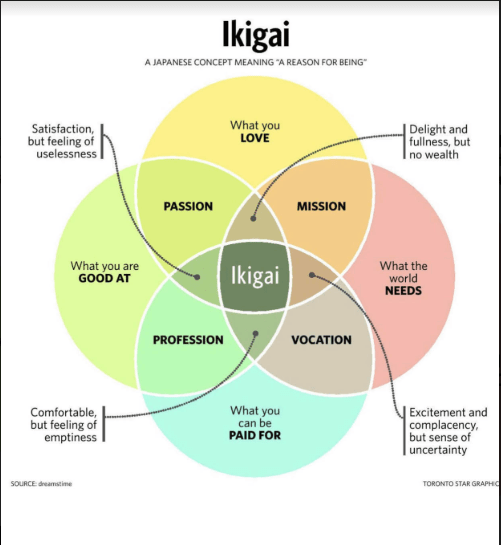
I recently received this graphic from a connection I have through LinkedIn. Thanks Tad Stephens for sending this to me. When I looked at this and put my business to the test, I found it very hard to keep our efforts trained on the center. Achieving Ikigai, having a real reason for being, takes incredible focus and discipline. Achieving that level of balance between abilities, love, world needs, and financial reward is not easy. There are times when I just want to do what I love, which is write. But it has become quite obvious to me that what I write is not always what the world needs (or more accurately wants) and I certainly have not accumulated great wealth from my writing. But, I do love to write and I’ve been told by numerous people that I’m pretty good at it.
Writing this Blog has been my attempt at finding out what the world needs. So far, some of my Blog posts have been viewed by several thousand people through LinkedIn. Other posts have been seen by just a few hundred. In looking at what people land on the most, I’ve seen that people have been most attracted to posts that focus on values and how those values effect what we do. The posts that have had the least following have been more personal thoughts about leaders who fall short on being values driven. I’m not sure, however, why an article about leadership and integrity, caring, and courage gets only 875 views in a week’s time while an article about leadership and caring got over 4,000 views in a week and now stands at 12,800 views in 4 weeks. You see, this is my dilemma, I’m not sure what the world is telling me it wants. And even more intriguing, what will the world pay for?
Because I think I’m pretty good at writing and I love doing it, I obviously have a passion for writing. I have written hundreds of articles over the last 20 years. Hundreds of these have been published. I have also co-authored 3 books and written one by myself. Two of the books have been distributed world wide and more than 10,000 copies are in circulation. For non-fiction books, that is a pretty big distribution. People have wanted to read these books but, alas, the world has not been willing to really pay for them. They’ve always been distributed to community groups as part of non-profit work my co-author, Kent Roberts, and I did for more than 15 years. We know people have loved the books because they have told us so. How do you translate what you are good at and what you love into a financial positive based on what the world truly needs.
The topic of my latest writings, and the name of this Blog, is Legacy Leadership. I know this is what the world needs but I’m not sure the world realizes it yet. There is some confusion about what Legacy Leadership is and perhaps that should be reiterated constantly so people will know what we mean when we say Legacy Leadership. Legacy Leadership is based on leaders wanting the Legacy of the Organization to be independent of the leader’s charisma or lack of it. Legacy Leaders want the purpose of the organization to prevail because of the values and principles upon which the organization operates not the personality of that leader. Many organizations succeed because there is a strong leader that can inspire people to do extraordinary things but when the leader is gone, all of the great initiatives put in place too often fall apart. I’ve seen this happen over and over. Legacy Leadership wants the organzation to be inspired by something associated with the organization itself and then no matter whether the leader is charismatic or somewhat uninspiring, the organization flourishes because it always operates based on values that are commonly held and applied at every level and in every segment of the organization. Great things naturally happen because the organization is set up to allow those great things to happen and the culture of the organization promotes the behaviors that make certain that those great things are honored and supported. People love being there, they are good at what they do, their passion shows. The organization has found what their world needs and that world is willing to pay for these products and services. In the case of our business, Culture By Choice, we have hit on all of these points and what we are now trying to do is expand the size of our world.
When I look at the graphic at the beginning of this post, I see that every Legacy Leader is trying to achieve Ikigai. Achieving a Legacy Culture means having a real purpose for the organization and then staying true to that purpose. Legacy Leaders want their organization to find that sweet spot where what we all love doing, intersects with what we are really good at doing, what the world really needs, and what the world is willing to pay for. When that intersection becomes the real purpose of the organization, I cannot imagine that organization failing. But, if finding that intersection was easy, everybody would find it. And then, it appears to me that this intersection is not like the intersection of State and Adams in Chicago. What the world wants and needs is not always the same. It can change. And what the world is willing to pay for is not stagnate either. These are moving targets. We must be agile in what we are doing. What the world wanted in 1970, or in 2010 for that matter, is not what the world wants in 2019. If an organization wants to be successful today, it must be able to adapt to what the world wants and is willing to pay for today, not what it wanted and was willing to pay for in 1970. And to achieve Ikigai, your organization must find these two new points on the map without losing their love and capacity to deliver a service or product. To continuously remain in a state of Ikigai, an organization must be agile yet rooted in stedfast vlaues and principles. That is the true challenge for every organization.

 Cheryl Lohner
 drjbnewman
 Newman’s Legacy Leadership Blog